Showing posts with label episcopal church. Show all posts

Monday, June 5, 2017

The dragon slaying days are never over

It began a couple of months ago with The Word... well, at least it was then that we heard word of the need of a new chasuble for the upcoming ordination of the Rev Michael Sahdev as priest.  There were a couple of discussions, emails back and forth, and then we readied our vision for his approval.


From there,  we discussed the the measurements and convened on a choice of fabric.


The design was nearly ready, except perhaps, refining the details of the chalice motif for the centre of the chasuble.  The chalice and paten/host are the symbol of the Eucharistic ministry of a new priest and the service he performs in command and commemoration of Our Lord in that rite we know as The Mass. Michael had seen patches with embroidered chalices before... but we imagined something unlike what is done elsewhere these days.  The image was in the mind... then out into a quick sketch, and a request for a little faith, as always, for the cartoon of the design can't compare to what we know it can become.

So off to the works: engineering three-dimensional forms in a computer so they become fabric and thread - easier said than done.


The head is too small to get a good likeness.... so what if we take a bead of ivory and carve it?  Done.
Saint Michael's head of nobler material could not be.  And the priest-to-be worried, "what if it falls off?"  But nothing many rows of thread - and yes, a bit of jeweler's glue too - could not secure.  It shall be attached still a hundred and two, and three hundred years from now, when we are all gone and it is used by another priest, or enshrined in a cathedral museum somewhere.  These vestments are to serve not just at the altar, but as testament of our sacred arts, our devotion and represent the customs and the culture of our times.  Should someone forget how and in what regard religion was held in our days, they should see this and trust in our resolve, our witness of the faith was deliberate, and steady, and respectful.  This is our witness.


So along came the halo and the wings, and the dragon at his feet (with a little forked tongue hanging to the side, for the devil is slain, defeated, pierced by the archangel's spear and no longer cause for fear as the story goes).


And there were pearls, as the clouds upon which the fight of good and evil once ensued.  And then a shrine to protect its memory and encapsulate it, for this chapter described in the tiny scene, dynamic and symbolic, is but part of a larger mystery: that of the chalice and host which represent the blood and body of Christ.


The little shrine takes the place of the knob which is ubiquitous in the chalices used in the Christian liturgies.  In the medieval and Renaissance periods there are instances of this, so Gothic gables and forms were used to harmonize the whole.


Issuing from the chalice and host are rays of light of gold, for they represent the covenant of our salvation by following the precepts of Christ: foremost of which is to drink the wine and eat the bread in memory of Him.


Here we see Father Michael during the celebration of his first mass and perhaps the symbolism is clearer than ever.  While he consecrates the bread and wine at the altar, the design on his chasuble is a visible symbol of the salvific mystery being carried out in the said consecration.


As chalices go, it is apt that he was given a token one by the Bishop during the ordination, and a real one by the members of the Vestry of the church where he was baptised, confirmed, and worshiped until this Saturday when he was ordained at the Cathedral and returned to the church for his first mass.


We hope he wears this chasuble on every anniversary of his ordination and be reminded not just then, but every time he  has to vest it, of the weighty office and tasks, but also the great honour of serving as the agent of salvation for the faithful and even those who perhaps do not yet belief - but attracted by the shine of the chalice, the beauty of our religion which is designed to echo the Holy! Holy!Holy! chanted in heaven, be instructed into its deeper meaning, and the reason of its being.


May your patron in the little shrine, Saint Michael the Archangel, guard and protect you, Father, and may he help you defeat the evils of the world so that the mystery of salvation contained in the chalice be accessible to all. Thank you for allowing Klave Centesca the opportunity to add to the treasures of Our shared Christian faith for now and posterity, and may the Peace of the Lord remain always with you.

The Legend on the design reads: IHS : MICHAEL + PRIEST + JUN 3 + A.D. 2017 + as testament of the day it was first used.    So as we say back home: Ad multos annos!

Friday, October 7, 2016

Sarum Blue is at once most blue and also....violet


Sarum Blue has been a controversial subject.  We have been commissioned a couple of times to make something in that Liturgical Colour... and as always, we at Klave Centesca try to do a certain degree of  research before embarking on any project.  It is always good to learn new things!

Turns out we see this meme all the time out there:


And yes, it has been posted in reference to our blue vestments:


So let's go down the rabbit hole:


  Yes, these are three chasubles depicted in manuscripts ranging between the 10th and 15c., and yes they are quite blue.  Are they Sarum?  No, but the important thing is that they ARE blue.. ultramarine blue in the first two images, to be exact, which is the pigment often used in those days to achieve this colour from the painstaking process of grinding the mineral lapis lazuli.  


The other choice of blue pigment was made out of cobalt... both rather bright, definitive, shades of blue.  


But... it is true... the ordines and rubrics of the Church don't generally consider blue as a liturgical colour... yet it appears not just in chasubles... but also in the form of copes:


And then, also in the form of choir dress: are certain of these cardinals wearing blue cappa magnas?


Are these French Prelates all in blue choir dress too?


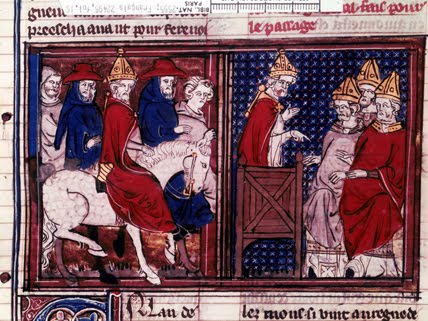
Well, it's not some conspiracy.  Turns out, the French Prelates are all Bishops - they are actually wearing violet mozettas (aka camails, in French) lined in amaranth red as prescribed for their hierarchy to this day... just that in painting, back before acrylics and oils came in tubes, blue was still made out of ground lapis and smelt and other proprietary recipes...and was used to "depict" the prescribed "violaceus" hues of the church.  


Yes, that is how in this beautiful images of a papal chapels, processions and consistories, there are red Cardinals and a few "blue" prelates too:


And just as art imitates life... eventually, life imitates art.  This is an extant Halberstadt blue chasuble from the 13c. Keeping in mind that textile colours do fade with time.


But if textiles fade, certainly the stained glass windows and illuminated manuscripts that are part of our collective patrimony, culture and memory, do not.  So to those who question the existence of Sarum blue... and then it's bright incarnations as royal, azure, lapis and cobalt... well... look at the rubrics and when is it used: Advent... when violet is called for... and look at the evidence above where these bright blues are used to depict whatever the church prescribes as violet in art: from the choir dress of bishops, to the court dress of domestic prelates of the pope, and vestments in places outside the use of Sarum where "blue" is not an option but violet always is.  Sarum blue is not an anomaly.  And these bright hues, end up closely resembling the historical ultramarine obtained from the lapis.

 
 Hence. voila!
Sarum blue is at once most blue, and also... violet. Technically.
:)


Here are links to two of our featured blue sets, if you'd like to revisit them:


Wednesday, August 10, 2016

Lion of Saint Mark Church Banner and Stand

Today is World Lion Day, apparently.  In heraldry, lions are featured prominently, and hence why we've become familiar with them over time.

In one instance - more vexilological than armorial perhaps -  we've outdone ourselves with the particular item featured today.  This, is the Banner we made with the lion of Saint Mark embroidered in 3D using a technique called stumpwork.


It is a bit like additive sculpting - if it were clay - but mind you, the whole thing is made of fabric and thread and just the right bits of padding to achieve the three-dimensional features of the big cat.


Once we had the banner - a stand like this wouldn't do, would it?  The kind used in police stations, schools and the Department of Motor Vehicles?!


So... accordingly, the pole is covered in velvet, and so is the custom-made stand.  We used the method employed for covering the chairs-of-state since elizabethan times in England.   Would also  look nice as a stand for a Paschal Candle or the 6 Candles around a catafalque, yes?


But back to our banner: because it is the banner of a church proper, it got topped with a cross to match the stand.


But how does one even begin the process to get a glorious custom-made banner?  Contact us, tell us what you have in mind, we sketch a few proposals and you choose whar you like or do not like and in the end, the results speak for themselves, we hope.


Here are some of the initial proposals based on the discussions with Father Bob and Mother Liza about the design.


We knew the colours would be red and blue; just not sure in what order.  Also, if to go with a colorful lion or something more fierce. Mind you, it was option C that was chosen for the colour scheme.  The colorful feline inspired by the book of Kells did not win favor in the end.


This one, from a mosaic at Trinity Cathedral became the model to follow.


A cartoon was drawn to suit our purposes, and the embroidery was made.  The end result always looks better than the cartoons... it takes a little imagination and a whole lotta faith,  But it's always worth it.


And thus, we end as we started, with the face of the lion in the banner of Saint Mark's.  All for about the price of one of the ready made banners one gets from your average catalog!

#worldlionday


To see the stand in blue velvet and the Banner made for the DOK, go here.