Showing posts with label EF mass. Show all posts

Tuesday, January 16, 2018

A Chalice Pall Original


Last December we had the honour to work on a Chalice Pall for Canon Francis Altiere of the Institute of Christ the King in Kansas.  This is a square of linen stiffened with board which is used to cover the chalice while it is at the altar.  This prevents foreign objects (which can range from pieces of plaster from the ceiling to gnats, or even the strong aroma of the incense) mixing with its contents.  As with everything connected with the honour and glory due to God, it is fitting to render it as beautifully as our humble hands and imaginations can manage.  This is the result of our latest efforts:


It was a special piece since we worked on it through the Feast of the Expectation (also called "Maria de la O" because of the "Oh-Antiphons" sung that week) which is the octave preceding Christmas.  It paralleled the labors of the Virgin Mary and by the 25th, as the new-born King was celebrated, so too His name had already been embellished with these pearls on Wisdom in the pall.


Aptly, it reached Canon Altiere in time to be used for the Epiphany. You can see images of the celebration at the Old Saint Patrick's Oratory facebook page.

We would like to share our process towards making our one of a kind pieces when we are commissioned here at Klave Centesca.

We usually have an initial communication to understand the purpose, place, and circumstances for which the work is required.  Sometimes it is the look of a chalice, style of an altarpiece or time period which sparks the imagination.

The image is then translated into a couple of design options.  In this case, we had discussed a sunburst with the IHS in the center, perhaps embellished with some pearls:


From the initial choices, we have a starting point to tweak the design further.  We always aim at creating a one of a kind piece.  


Once digitized, we discussed a few other options and came up with these further variants after settling for the "Romanic" border with pearls.

 
Then which trim to choose?


And finally after we convene on the final details, the piece is finished. 

The Chalice Pall with Pearl Embroidery in white Linen and Gold commissioned by Canon Francis Altiere, Christmas 2017


Picking and choosing from the different options is always a possibility, as in this case Canon Altiere suggested using the same metal flowers he had seen on a mitre we did a couple of years ago but without the embroidered rosettes:


 As you can see, this is why we always call our pieces a collaboration.  Coming up with something extraordinary is our mission, but greater things always come out when we work together with you.

Be mindful that all the other unrealized designs are still available to commission, all you have to take is the first step and contact us by writing to info@klavecentesca.com 

Happy New Year to All! 

May Christ's Light Shine on All.


Sunday, July 9, 2017

The Instruments of Peace

Today, we will highlight a little liturgical trinket which we call The Instrument of Peace, Portapaz or Oscularium which are as descriptive of a name as those paintings called "Child with a chair" that contain quite rightly: a child and a chair.

Portapaz of Christ-Child ON a Chair... just pure coincidence :)

It is the Instrument of Peace because it is used during the part of the mass in which the Peace is ritually required in order to proceed with the Eucharistic celebration.  That part where you normally turn to you neighbor and shake hands or kiss them as a signal that you do not hold grudges, or if you did, you forgive them so that the Peace of the Lord is manifest and all can proceed to take communion... having "forgiven our debtors" ... (Hint: It's in the 'Our Father'!)


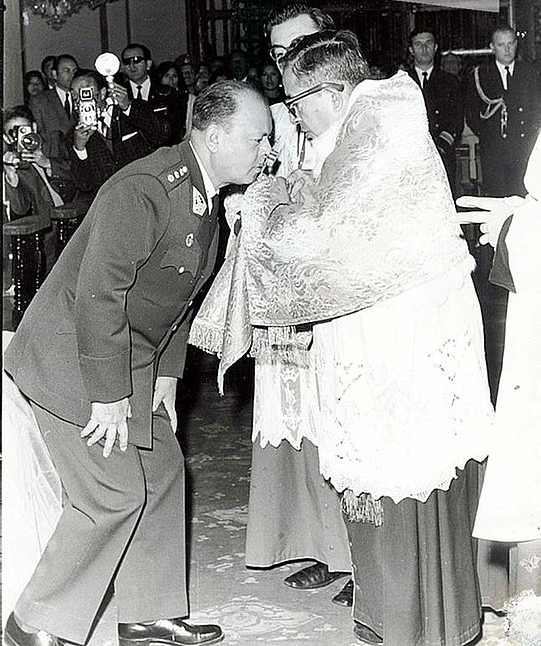
It is often a piece of embossed, carved, bejeweled or embroidered panel which is kissed by the priest and taken round to others to kiss also.  Hence, it is called an oscularium (osculo=kiss in Latin).

The Archbishop of Santiago de Compostela maintains our tradition of kissing an Instrument of the Peace - one of many in the wonderful collections of the Archiepiscopal Treasury.

In the back it has a protuberance in the form of annulus or hook so the cleric who carries it ("the symbolic peace of the Lord") can better handle it without dropping it or faltering in his grip.


There are quite beautiful examples of it, and indeed its use spread at certain points to different rites across Christendom.  It has been used in England, in Italy, France, Germany, and of course, Spain and its places of influence in the New World.

This is the Portapaz of Pope Leo XIII in the Vatican Museums which also hold a treasure-trove of Portapaces:

Its use stems from the particular solution in our GotHispanic Rite, and its Mozarabic branch, to conveying the peace during the Feriae from the celebrating priest at the altar, to our family or our representatives occupying the second-floor tribune at the western or northern end of the nave or transept.   Conveying the peace with a Portapaz via a cleric in his surplice (or further with an esclavina or manteo too if privileged as an Almoner) then allowed for the 'ritual peace' to be taken from the celebrant's lips, and  up the stairs to the tribunes of our particular chapels, without the priest or his ministers needing to exit the sanctuary nor the persons in state descending - which would cause unnecessary distraction to the rest of the faithful for an ordinary day.  In our rubrics it demands that it only be used on the Feriae, and not on the memories, feasts or solemnities, when instead of the tribune we occupy part of the choir. Since time immemorial, however, it has become customary to use it on these other occasions too since it is easier to have the cleric pass in front of the prie-dieus and offer the Portapaz in succession without anyone having to stir much as done for the Communion; everyone else present gives and receives the peace in the customary manner.


As occasions demand, sometimes two instead of one Oscularium is used to carry the peace to those in the Choir: one for those on the North and another for those in the South.  This is especially the case where the the men and women segregate on specially solemn occasions.  Four Portapaces are used thence where nuns occupy one choir or enclosure and monks the opposite one at a monastic basilicas catering to communities of the both sexes, which in essence constitute a double transept or choir so all may do as the Deacon proclaims in a loud voice in our rite: "Quomodo astatis, pacem facite!"   = As is your state/Where you Stand, make peace!


In yet other places it is now taken to a specific spot and people line up to kiss it - which is a new invention.  In the other rites, however, the command to give each other the sign of the peace is not as specific as in ours.  In either case, lining up to kiss it treats the instrument of the Peace as a relic, and though the object is often carved with images, scenes and representation of God, Saints and Holy things, it is not a reliquary nor is the purely-ornamental image to be venerated.  The object is supposed to convey the Peace in a manner that is less disruptive to the liturgy, not to become a distraction.  We hope these things are taken into consideration, though obviously each particular culture and setting should provide for its own norms, and the rest respect them as long as they do not deviate from the central teachings.


In any case, we have it held with the left hand, and wiped with a linen towel held on the right hand. In the Roman Rite, those privileged to use it by papal dispensation from the 16th century on, hold it with a humeral veil instead:


So with all that,  Peace be with You!

As our nuns from San Pelayo sing:

Pacem meam do vobis, pacem meam commendo vobis: 
non sicut mundus dat pacem do vobis.

Novum mandatum do vobis ut diligatis vos invicem. 

Pacem meam do vobis, pacem meam commendo vobis: 
non sicut mundus dat pacem do vobis.

Gloria et honor Patri et Filio, 
et Spiritui Sancto in saecula saeculorum. Amen.

Pacem meam do vobis, pacem meam commendo vobis: 
non sicut mundus dat pacem do vobis.


Friday, July 7, 2017

Pontifical Gloves

Pontifical Gauntlets are one of those things we do not see too many of these days... so we are always happy when we have the opportunity to make some.  These pairs are on their way to Hungary.  We couldn't wait any longer to share the story though, since it highlights what we enjoy doing best: learning about history and making new things which can relate to the past so traditions survive at least on our watch.

Pontifical Gloves by Klave Centesca With Embroidered Gauntlet Cuff inspired by Hungarian Coronation Chasuble
The purple ones we hinted at before on social media, and here they are:


The design of the cuff, because they were made for the Hungarian Church, we thought it would be nice to find inspiration in some of their beautiful vestments from the past.  Looking through the various collections, we found this:

Chasuble used at the Coronations of Hungarian Kings 
It is a gold chasuble embroidered with tiny seed pearls using the traditional Hungarian tulips motif.  It even has amethysts and other jewels running down the centre - making it quite literally, a "planeta pretiosa" or precious chasuble which begs the question: where is the matching precious mitre?!

The said chasuble is unlikely to be worn with the pontifical gauntlets we have made at Klave Centesca, but if we had to find inspiration, where best?  Instead of pearl embroidery, we have used the raised goldwork which is more traditional for these liturgical gloves worn at pontifical masses, and we are quite happy with the effect of them.  But with custom work... the possibilities are quite endless.

Here's a couple of different projects from the past:

Pontifical Gauntlets with English Roses, French Fleurs and Canadian Maple Leaves 
Pontifical Gloves with a Jesuit Sun.


And a guide to some of the styles:


Does your bishop have pontifical gloves?


Friday, October 7, 2016

Sarum Blue is at once most blue and also....violet


Sarum Blue has been a controversial subject.  We have been commissioned a couple of times to make something in that Liturgical Colour... and as always, we at Klave Centesca try to do a certain degree of  research before embarking on any project.  It is always good to learn new things!

Turns out we see this meme all the time out there:


And yes, it has been posted in reference to our blue vestments:


So let's go down the rabbit hole:


  Yes, these are three chasubles depicted in manuscripts ranging between the 10th and 15c., and yes they are quite blue.  Are they Sarum?  No, but the important thing is that they ARE blue.. ultramarine blue in the first two images, to be exact, which is the pigment often used in those days to achieve this colour from the painstaking process of grinding the mineral lapis lazuli.  


The other choice of blue pigment was made out of cobalt... both rather bright, definitive, shades of blue.  


But... it is true... the ordines and rubrics of the Church don't generally consider blue as a liturgical colour... yet it appears not just in chasubles... but also in the form of copes:


And then, also in the form of choir dress: are certain of these cardinals wearing blue cappa magnas?


Are these French Prelates all in blue choir dress too?


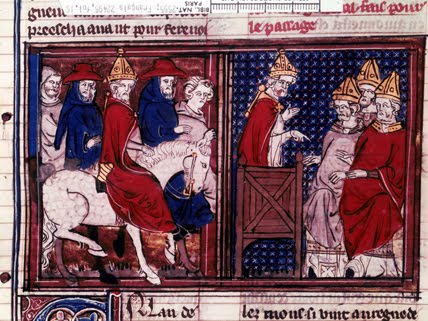
Well, it's not some conspiracy.  Turns out, the French Prelates are all Bishops - they are actually wearing violet mozettas (aka camails, in French) lined in amaranth red as prescribed for their hierarchy to this day... just that in painting, back before acrylics and oils came in tubes, blue was still made out of ground lapis and smelt and other proprietary recipes...and was used to "depict" the prescribed "violaceus" hues of the church.  


Yes, that is how in this beautiful images of a papal chapels, processions and consistories, there are red Cardinals and a few "blue" prelates too:


And just as art imitates life... eventually, life imitates art.  This is an extant Halberstadt blue chasuble from the 13c. Keeping in mind that textile colours do fade with time.


But if textiles fade, certainly the stained glass windows and illuminated manuscripts that are part of our collective patrimony, culture and memory, do not.  So to those who question the existence of Sarum blue... and then it's bright incarnations as royal, azure, lapis and cobalt... well... look at the rubrics and when is it used: Advent... when violet is called for... and look at the evidence above where these bright blues are used to depict whatever the church prescribes as violet in art: from the choir dress of bishops, to the court dress of domestic prelates of the pope, and vestments in places outside the use of Sarum where "blue" is not an option but violet always is.  Sarum blue is not an anomaly.  And these bright hues, end up closely resembling the historical ultramarine obtained from the lapis.

 
 Hence. voila!
Sarum blue is at once most blue, and also... violet. Technically.
:)


Here are links to two of our featured blue sets, if you'd like to revisit them: