Showing posts with label symbolism. Show all posts

Friday, December 14, 2018

And The Virgin is Quite Pregnant!


After the celebration of the Virgin of Guadalupe, patroness of the Americas, a child asked us "where is the baby Jesus?!" which stands to reason, as all depictions (it seems) show the Virgin holding the Christ-child.  Lupita, does not.


The simple answer, of course, is that Jesus remains in her belly!  Which at a certain age, it is still as paradoxical as Shroedinger's Cat to many an adult.  So many questions followed.... but the humorous anecdotes we shall leave for another day.

The Virgin of Guadelupe is almost an anomaly... for Catholics after the sixteenth-century Tridentine Council.   But She is an embodiment of the expectant virgin which since AD 656, is celebrated in the rites canonized by the Councils of Toledo.

The date falling within Advent is quite telling.  The feast of the pregnant virgin is instituted for the 18th of December (which begins on the eve, at sunset of the 17th).  This ancient feast was declared in order to honor the pregnant Virgin since the March-25th date fell during Lent, when no other feasts, solemnities nor memories of saints was allowed in the national rite of the Goths and those under their rule from Toledo.  Most apparitions between March 25th and December 25th, show The Virgin as pregnant, in our tradition.

Guadalupe is not an anomaly.  The Virgin of Lourdes appeared in similar guise in what today is France.


So did the Virgin of Fatima, in present day Portugal.


The virgin in the loose robe, with nothing but a bow around her high-waist is not an anomaly.  It is part of our symbolic language, tradition and culture as manifested directly from heaven. The baby is inside.  The iconography is not accidental.


Actually, before Trent, it was not just in present day Portugal, Spain, France and their respective colonies that one saw a pregnant virgin.

Even the eastern rites maintain their version.

The orthodox have Her as The Virgin of the Sign.  The Holy Fetus is depicted fully formed inside a luminous circle which references the "blessed is thy womb" of our Hail Mary.


Such imagery, were it current still... perhaps would help dissuade the Christians who favor abortion? An image of literal love even inside the womb, versus the graphic ones of dismembered fetuses outside of them?  (Just rhetorical).

Here are a few examples of the pregnant Virgin (Maria Gravida) from Germany:


And even Italy before the Tridentine Reforms:


And from France:
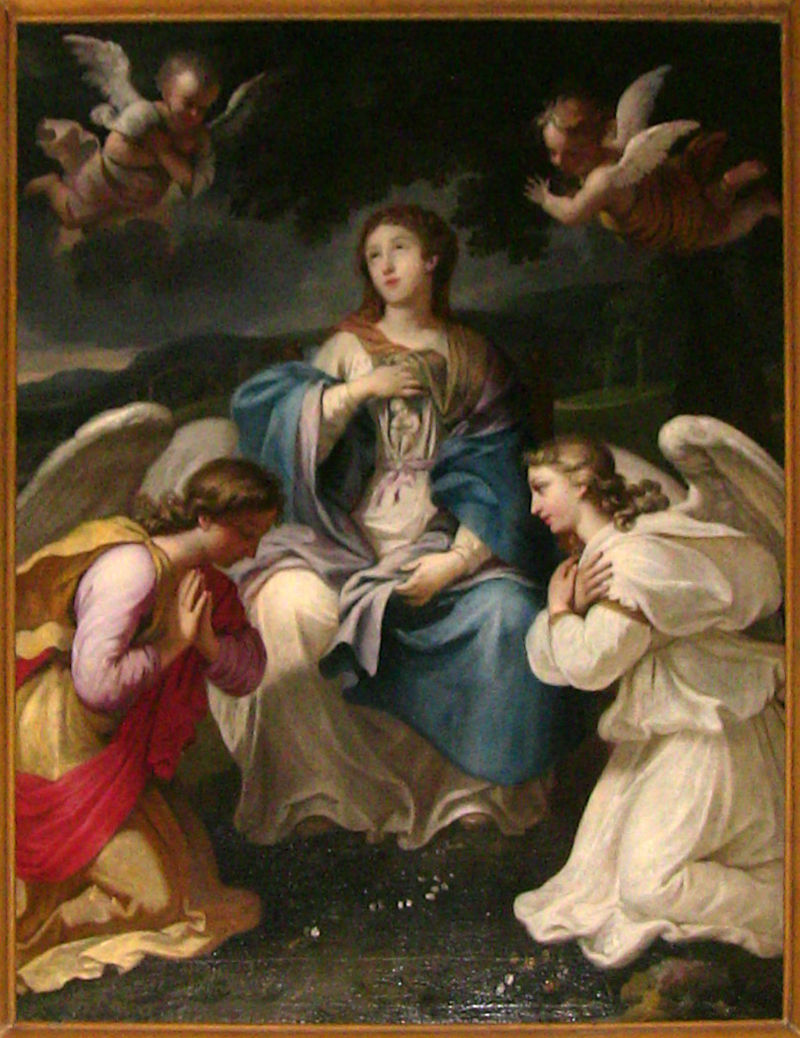

Portugal:


 And of course, Spain:


It is a shame that eventually it became taboo to be pregnant.  Even for The Virgin who never showed such a scruple when appearing to her blessed devotees... from antiquity to recent times.

We call her Maria de la O (in reference to the O antiphons intoned in her octave leading to the Feast of The Nativity: Christmas) but also call her Our Lady of the Expectation (she is, after all, expecting child) and also as Maria de la Esperanza: for it is in her uterus that The Savior is gestated... the source of all Hope-Esperanza.

But being enceinte-encintas, that euphemism which references the high-waisted girdle of the pregnant virgin, also remained ingrained in the words we speak.  It is still the polite way to refer to any pregnant lady.

Whether the holy fetus in her belly is clearly exposed, or not, she is ripe with child: The Virgin of Advent.  And this is Advent.  We remember, and thank Her for accepting the task of carrying the baby to term, her labours and the blessed fruit of her womb, Jesus...

...sometimes even with a baisemains-besamanos-beija-mão but we'll explore that on another post.  Happy Advent!


Monday, April 25, 2016

Obtaining a New Coat of Arms & Americans' Right to Freely Do So.


Today we would like to highlight one of the services we provide.  Namely, the design of new coats of arms for prelates of the Catholic, Episcopal, Lutheran and other denominations, who in virtue of their office, are entitled to assume coats of arms in the United States, distinguished by the ecclesiastical hat, crosier or mitre, as may be the particular case.

In the U.S., all free citizens are allowed to assume arms.   This fact goes beyond a discussion of the Second Amendment of the Constitution which states "the right of the people to keep and bear Arms, shall not be infringed" which is more generally referred to in political discussions of a different nature - about firearms primarily - which will not be entered here.

A coat of arms, however, does stem from a tradition in which a shield was wielded as a defensive weapon.  In the class-conscious societies prior to the American Revolution of 1776, these were the exclusive right of a privileged few only: royalty, the titled nobility and the lower nobility.  Merchants, farmers, burgers and peasants were generally excluded from the right of this sort of defensive weapon: the shield.  In some societies, like the Netherlands, Switzerland, and even France, some individuals were allowed arms albeit not belonging to the nobility.   These were called "armes roturiers" for yeomen and "burgher arms" when borne by common citizens.

It is this latter type of arms which all Americans are by law, entitled to assume.  Why assume?  Because unlike in England, Scotland or Canada - where the respective Colleges of Arms GRANTS you a coat of arms- in places where no authority holds that monopoly, arms are ASSUMED by the interested party.

To be fair, today the process of obtaining a blazon is less restrictive in Queen Elizabeth II's realms than in yesteryear.  Whereas before one needed to prove to be a descendant with a proper claim to bear the arms once granted to an ancestor, or via a special grace from the monarch to  even be eligible, today, any subject of those respective realms  can apply for a new design.  If you are a subject to one of these Kingdoms: that is still the only way to sport a coat of arms.  It also doesn't guarantee that your application will be accepted.

Prelates, from a simple chaplain to the Popes themselves, are also by tradition entitled to use arms.  This is especially useful in their clerical and magistrative capacities.  When exercising these, their seal on official documents, and official letterheads should include the coat of arms of the emitting authority.  This way, a relic, a baptism, marriage or death certificate can all be ensigned with a seal which can verify their authenticity for posterity.

All Americans, again, are free to design and use the ones they please... well, in a way.  As with everything, there are rules and conventions which ought to be followed.  For this reason, it is best to consult an expert in heraldry to either design one for you or advise you as to the correct way to go about it.  People who proceed by themselves tend to overcrowd the field trying to represent every aspect of their life - a veritable curriculum vitae! - which defeats the purpose of a clear and concise depiction which can be easily distinguished from other samples.  That is one of the essential aims of heraldic achievements: to identify you and your state without actually writing out your name.  There is also a further problem to avoid: assuming the arms of someone else! Another would be: using external ornaments which belong to a hierarchy not one's own.  So consult us directly if you would like to design a coat of arms for personal or official use.  We can readily help you through the process ourselves, guide you to other reputable designers or the pertinent state agency if you live in one of the countries with a College of Arms or other such regulatory bodies.  In any case, we do love embroidering these on vestments!  Painting them on board-paper or canvas is also a possibility.  Here are some samples of the ones we have embroidered for other armigerous priests:


You can see more at http://klavecentesca.com/gallery.html  All we do is custom - and yet, affordable! For it should be accessible to those in the good service.

But without further ado, though, we leave you with the arms we've recently designed and illuminated for a local priest: The Reverend Father Mark Andrew Jones, BSG,  as Rector of Saint Nicholas.


Father Mark Andrew's arms are canting his christian names by depicting the symbols of Saint Mark and Saint Andrew.  The scales of justice recall his profession in the law before and beyond answering his priestly vocation.  Over all, is the ecclesiastical hat which denotes his clerical state, and the two tassels that hang from the cords on each side, his hierarchy as Rector.  The motto is an homage to the Brotherhood of Saint Gregory, to which he has made vows.

To close: the blazon itself.  This is the coded language from which any other herald should be able to replicate his coat of arms henceforth.

SHIELD: Per fess I: Gules, St Mark's winged-lion passant Or, halo and book Argent;
II: Azure, Saint Andrew's cross Argent with a scales Or.
EXTERNAL ORNAMENTS: Galero with 2 tassels from cords on each side, Sable.
MOTTO: Soli Deo Gloria

Wednesday, December 9, 2015

PELICAN IN PIETY

The Pelican-In-Piety refers to a very ancient symbol for Christ.  The Pelican is known for the ultimate sacrifice to save its chicks.  It prick its sides to feed them the blood that will sustain their life.  Christ gave his blood for us, and at communion, the wine drunk is in remembrance of that sacrifice.
So the Pelican isn't just a bird - and what better way to make a child or adult understand the sacrificial nature of Christianity, than with a conversation begun about the bird on your vestment?