Showing posts with label liturgical colours. Show all posts

Friday, July 7, 2017

Pontifical Gloves

Pontifical Gauntlets are one of those things we do not see too many of these days... so we are always happy when we have the opportunity to make some.  These pairs are on their way to Hungary.  We couldn't wait any longer to share the story though, since it highlights what we enjoy doing best: learning about history and making new things which can relate to the past so traditions survive at least on our watch.

Pontifical Gloves by Klave Centesca With Embroidered Gauntlet Cuff inspired by Hungarian Coronation Chasuble
The purple ones we hinted at before on social media, and here they are:


The design of the cuff, because they were made for the Hungarian Church, we thought it would be nice to find inspiration in some of their beautiful vestments from the past.  Looking through the various collections, we found this:

Chasuble used at the Coronations of Hungarian Kings 
It is a gold chasuble embroidered with tiny seed pearls using the traditional Hungarian tulips motif.  It even has amethysts and other jewels running down the centre - making it quite literally, a "planeta pretiosa" or precious chasuble which begs the question: where is the matching precious mitre?!

The said chasuble is unlikely to be worn with the pontifical gauntlets we have made at Klave Centesca, but if we had to find inspiration, where best?  Instead of pearl embroidery, we have used the raised goldwork which is more traditional for these liturgical gloves worn at pontifical masses, and we are quite happy with the effect of them.  But with custom work... the possibilities are quite endless.

Here's a couple of different projects from the past:

Pontifical Gauntlets with English Roses, French Fleurs and Canadian Maple Leaves 
Pontifical Gloves with a Jesuit Sun.


And a guide to some of the styles:


Does your bishop have pontifical gloves?


Friday, October 7, 2016

Sarum Blue is at once most blue and also....violet


Sarum Blue has been a controversial subject.  We have been commissioned a couple of times to make something in that Liturgical Colour... and as always, we at Klave Centesca try to do a certain degree of  research before embarking on any project.  It is always good to learn new things!

Turns out we see this meme all the time out there:


And yes, it has been posted in reference to our blue vestments:


So let's go down the rabbit hole:


  Yes, these are three chasubles depicted in manuscripts ranging between the 10th and 15c., and yes they are quite blue.  Are they Sarum?  No, but the important thing is that they ARE blue.. ultramarine blue in the first two images, to be exact, which is the pigment often used in those days to achieve this colour from the painstaking process of grinding the mineral lapis lazuli.  


The other choice of blue pigment was made out of cobalt... both rather bright, definitive, shades of blue.  


But... it is true... the ordines and rubrics of the Church don't generally consider blue as a liturgical colour... yet it appears not just in chasubles... but also in the form of copes:


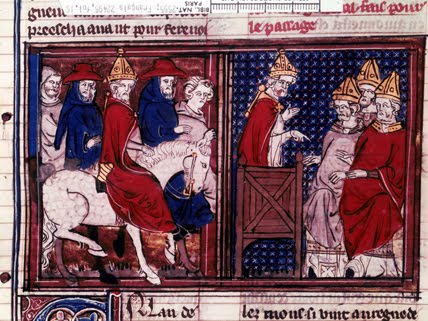
And then, also in the form of choir dress: are certain of these cardinals wearing blue cappa magnas?


Are these French Prelates all in blue choir dress too?


Well, it's not some conspiracy.  Turns out, the French Prelates are all Bishops - they are actually wearing violet mozettas (aka camails, in French) lined in amaranth red as prescribed for their hierarchy to this day... just that in painting, back before acrylics and oils came in tubes, blue was still made out of ground lapis and smelt and other proprietary recipes...and was used to "depict" the prescribed "violaceus" hues of the church.  


Yes, that is how in this beautiful images of a papal chapels, processions and consistories, there are red Cardinals and a few "blue" prelates too:


And just as art imitates life... eventually, life imitates art.  This is an extant Halberstadt blue chasuble from the 13c. Keeping in mind that textile colours do fade with time.


But if textiles fade, certainly the stained glass windows and illuminated manuscripts that are part of our collective patrimony, culture and memory, do not.  So to those who question the existence of Sarum blue... and then it's bright incarnations as royal, azure, lapis and cobalt... well... look at the rubrics and when is it used: Advent... when violet is called for... and look at the evidence above where these bright blues are used to depict whatever the church prescribes as violet in art: from the choir dress of bishops, to the court dress of domestic prelates of the pope, and vestments in places outside the use of Sarum where "blue" is not an option but violet always is.  Sarum blue is not an anomaly.  And these bright hues, end up closely resembling the historical ultramarine obtained from the lapis.

 
 Hence. voila!
Sarum blue is at once most blue, and also... violet. Technically.
:)


Here are links to two of our featured blue sets, if you'd like to revisit them:


Thursday, May 12, 2016

Pentecost Green! No, Red. No, Green! :)

Ever since Easter began, we've been busy making vestments in red.  That is the colour for Pentecost in the Roman Rite which practically everyone follows today in the West.

 The reasoning for the red is well documented in every liturgical book printed since at least the 1500s ... and even Wikipedia.  The green, however, is less obvious when one directly associates the holy ghost with red masses.

Green's use  is explained with the descent of the Holy Spirit beginning the period in which bishops went out and evangelized the peoples... in other words, the beginning of Ordinary Time in the Liturgical Year.  Hence follows, that the colour of bishops is green and why the galero on their coats of arms, seat covers and cushions are also by default green.   [Eventually, western-rite bishops began to wear purple (and the rochet, for example) as part of the now well-established privilege of being members of the Roman Pontiff's household.  Monsignori, who may or may not be bishops, thus, also wear purple by the privilege which affiliates them to the Papal household.]  Green represented the time when to carry out the pastoral visits by the bishops - when the fields themselves were green with life.  Green "cassocks" and "hoods" went out of history long ago for bishops, but the vestments and some paraphernalia remained.

Now that some context has been established, here is a rather magnificent set of paraments, presently at The Louvre, which were commissioned for  L'Ordre du Saint Esprit in the 16th century - whose major feast day was: Pentecost!  As you may appreciate, it is green, and replete with the flames associated with the descent of the holy ghost.

On this image one can see the Throne dais whose baldachin has the dove in the centre and the prie-dieu cover bears the royal arms embroidered in the front.  On the rear, the altar frontal, dossal and baldachin can also be seen.  The ceremonial robes of the Knights and Officers of the order also bear a small cape to match, in green, above the long black mantle.
Next, is an image of these pieces in use, during the King's reception of the oath from a new member: The bird which is in reality embroidered on the ceiling of the king's baldachin, is represented as hovering over the sovereign's head in the painting:

L'Ordre du Saint Esprit was established in 1578 by King Henry III in commemoration of having been elected King of Poland, and then inheriting the throne of France, coinciding with the feasts of Pentecost of 1573 and 1574 respectively.
Here can be appreciated the detail of the flames of the green camail (above) and of the overall effect of altar frontal (below) which also bears the King's heraldic achievement of a royal crown over the arms of France, and of the Polish-Lithuanian commonwealth.  They are circled by the collars of L'Ordre du Saint Michel, and the new Ordre du Saint Esprit.

So there you have it.  Green Vestments and Paraments used at the Royal Court of France for the Feast of Pentecost according to the Parisian Use of the Gallican Rite.  The Gothispanic (aka Mozarabic) Rite also uses green for this feast in the west.

The Eastern rites too, use green:  
Some, still deck the halls with green branches, flowers and trees:
And others go still further and "carpet" their churches with greenery as was attested by the Muslim chronicler, Almakkari, when referring to the Gothispanic mass already in the IX century.

Below, that practice still seen in Romania:

Interesting, yes?