Sarum Blue has been a controversial subject. We have been commissioned a couple of times to make something in that Liturgical Colour... and as always, we at Klave Centesca try to do a certain degree of research before embarking on any project. It is always good to learn new things!
Turns out we see this meme all the time out there:

And yes, it has been posted in reference to our blue vestments:


So let's go down the rabbit hole:


Yes, these are three chasubles depicted in manuscripts ranging between the 10th and 15c., and yes they are quite blue. Are they Sarum? No, but the important thing is that they ARE blue.. ultramarine blue in the first two images, to be exact, which is the pigment often used in those days to achieve this colour from the painstaking process of grinding the mineral lapis lazuli.

The other choice of blue pigment was made out of cobalt... both rather bright, definitive, shades of blue.

But... it is true... the ordines and rubrics of the Church don't generally consider blue as a liturgical colour... yet it appears not just in chasubles... but also in the form of copes:


And then, also in the form of choir dress: are certain of these cardinals wearing blue cappa magnas?
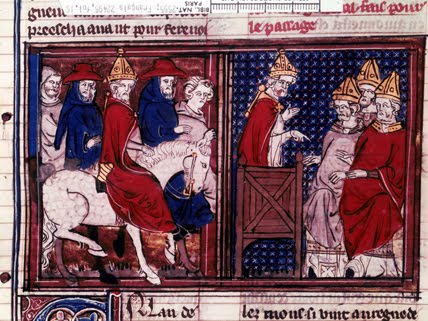


Are these French Prelates all in blue choir dress too?


Well, it's not some conspiracy. Turns out, the French Prelates are all Bishops - they are actually wearing violet mozettas (aka camails, in French) lined in amaranth red as prescribed for their hierarchy to this day... just that in painting, back before acrylics and oils came in tubes, blue was still made out of ground lapis and smelt and other proprietary recipes...and was used to "depict" the prescribed "violaceus" hues of the church.


And just as art imitates life... eventually, life imitates art. This is an extant Halberstadt blue chasuble from the 13c. Keeping in mind that textile colours do fade with time.

But if textiles fade, certainly the stained glass windows and illuminated manuscripts that are part of our collective patrimony, culture and memory, do not. So to those who question the existence of Sarum blue... and then it's bright incarnations as royal, azure, lapis and cobalt... well... look at the rubrics and when is it used: Advent... when violet is called for... and look at the evidence above where these bright blues are used to depict whatever the church prescribes as violet in art: from the choir dress of bishops, to the court dress of domestic prelates of the pope, and vestments in places outside the use of Sarum where "blue" is not an option but violet always is. Sarum blue is not an anomaly. And these bright hues, end up closely resembling the historical ultramarine obtained from the lapis.


Hence. voila!
Sarum blue is at once most blue, and also... violet. Technically.
:)

Here are links to two of our featured blue sets, if you'd like to revisit them:


